The Narcissist’s Prayer
by Dayna Craig
That didn’t happen.
And if it did, it wasn’t that bad.
And if it was, that’s not a big deal.
And if it is, that’s not my fault.
And if it was, I didn’t mean it.
And if I did, you deserved it.

Have you ever had to navigate a relationship with someone who treats you this way? The narcissist in your life could be a family member, a friend, or a romantic partner. Regardless of the nature of your relationship with this person, narcissistic abuse leaves us feeling alone, defeated, and beyond frustrated. Often, the goal of any narcissist is to make you feel like you are the problem. They have your head spinning to the point where you may feel like you no longer recognize yourself.
You are not alone. Those who have survived a relationship with someone who has narcissistic traits can feel deeply isolated from everyone around them, which is why connection with other survivors can be critical for healing. Our group, Reclaiming Me, aims to create a sense of community and connection between women and female-identifying persons who have experienced similar relationships. We started this group to give a voice to those who have felt silenced, unheard, and alone.
This is a psychotherapy group that will create a safe and supportive atmosphere for you to develop tools and coping skills to manage the effects of a relationship with a narcissist. But most importantly, this psychotherapy group is meant to be a safe space where you can feel understood by supportive therapists and other survivors of narcissistic abuse. Together, we will learn from our similar lived experiences, form meaningful connections with each other, and learn how to reclaim our lives.
To learn more about narcissism, read on!

The journey with a narcissist can be subtle and insidious, marked by emotional manipulation and an erosion of self-esteem. Recognizing these patterns is the first step toward healing. We don’t just offer support in our groups but foster a deep understanding of these complex dynamics.
As we move forward, we’ll explore the nuances of narcissistic relationships and the transformative power of shared healing. The following sections will guide you through recognizing and coping with these challenges, marking the start of a journey toward reclaiming your self-worth and peace.
At See You Through It Counseling, we recognize the profound effects that relationships with narcissists can have on individuals. Our focus in our narcissistic abuse support group is to address these impacts, offering insight and empathy to those who have experienced them.

Emotional and Psychological Effects
Relationships with narcissists often lead to significant emotional and psychological challenges. You might find yourself grappling with self-doubt, a persistent sense of confusion, and feeling emotionally drained. This erosion of self-esteem and identity is a common outcome of such relationships, leaving individuals questioning their worth and reality.
The Isolation Felt
A particularly challenging aspect is the isolation that often accompanies these relationships. This isolation can manifest as a disconnection between one’s emotions and others, creating a profound loneliness. In these moments, the support of a group, where others truly understand your experience, becomes invaluable.
Long-Term Consequences
Narcissistic relationships can leave lasting effects, influencing how you view and engage in future relationships and your personal growth. Issues like mistrust or a distorted perception of healthy relationships are not uncommon. Recognizing and addressing these patterns is essential for personal development and emotional well-being.
Understanding these impacts also opens the door to addressing and managing them. The following section will focus on recognizing the signs of narcissistic abuse. Identifying these signs is crucial in breaking harmful cycles and fostering a sense of empowerment. In our support groups, we discuss these signs openly, creating an environment where learning and mutual support flourish.
In the realm of personal relationships, understanding the signs of narcissistic abuse is crucial. At See You Through It Counseling, we address these signs in our narcissistic abuse support group, guiding individuals to recognize patterns often overlooked or misunderstood.
Identifying the Signs
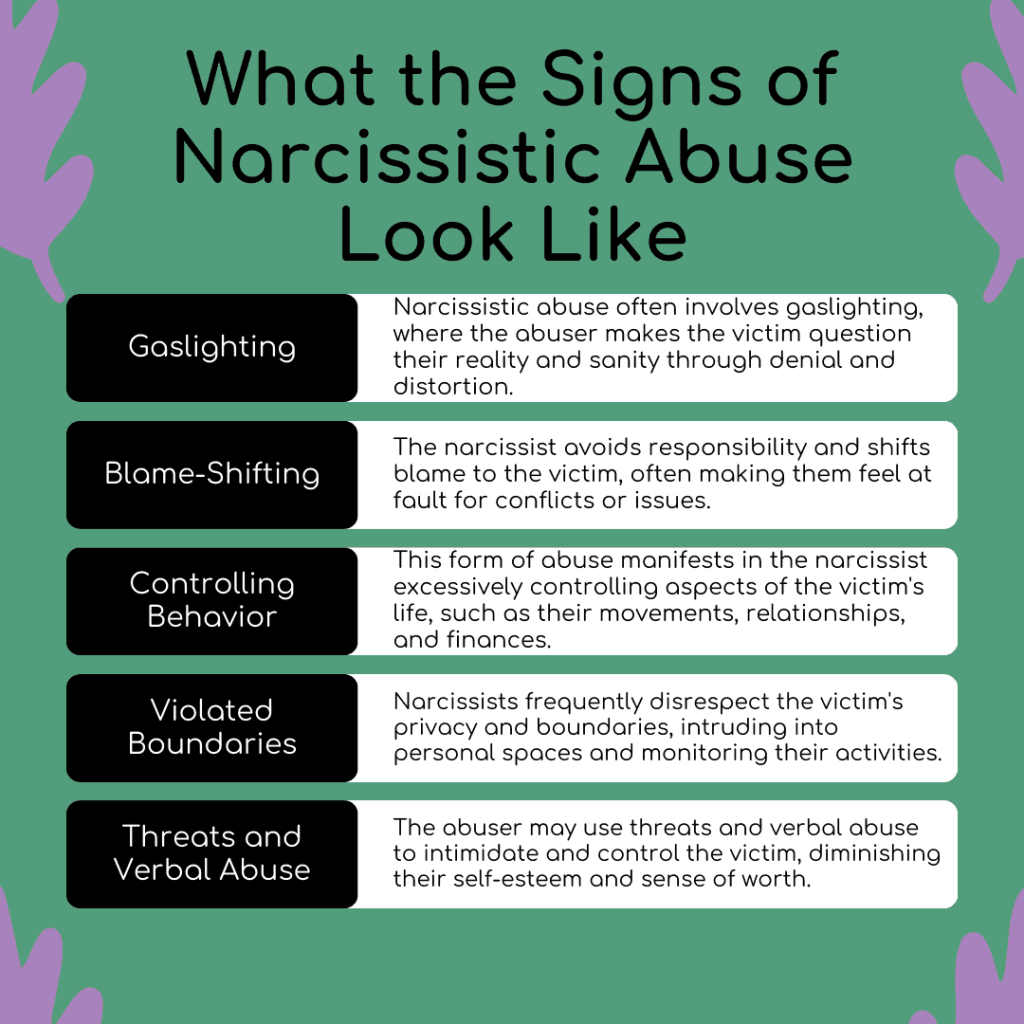
Narcissistic abuse can be elusive and complex, making it challenging to identify. It often involves subtle forms of emotional manipulation like gaslighting, where your reality is continually questioned, or blame-shifting, where responsibility is deflected. It involves controlling behavior like restricting where the abusee can go, who they can hang out with, or how much money they can spend. It also usually means a lack of privacy and violated boundaries for the abusee. Finally, it sometimes involves threats and verbal abuse. These tactics can leave you feeling perpetually at fault and doubting your perceptions.
Understanding Manipulation Tactics
Manipulation in these relationships can take many forms, from subtle undermining to overt control. Recognizing these tactics is the first step toward addressing them. It’s about seeing the pattern behind the actions and understanding how these behaviors systematically erode confidence and trust.
Imagine a scenario where a partner frequently criticizes small aspects of your behavior or appearance. These critiques are often subtle, perhaps wrapped in a guise of ‘just joking’ or ‘constructive feedback.’ For instance, they might make a dismissive comment about your choice of clothes, or lightly mock a decision you made at work.
Over time, these criticisms start to build up, making you second-guess your choices and lowering your self-esteem. However, just as you start to feel down, the same partner switches tactics, offering praise or affection. This sudden shift might leave you feeling temporarily uplifted but also confused and dependent on their approval for your self-worth.
In this cycle of criticism followed by praise, the underlying pattern is one of control. By constantly shifting the dynamic from negative to positive feedback, the manipulator keeps you off-balance. You start relying on them to feel good about yourself, eroding your confidence and trust in your own judgment. Recognizing this pattern is a critical first step in addressing the manipulation and reclaiming your self-esteem and independence.
Differentiating Narcissistic Abuse from Normal Relationship Challenges
It’s important to distinguish between the usual ups and downs of relationships and the consistent, damaging patterns of narcissistic abuse. While all relationships face challenges, those dominated by narcissistic traits have distinct characteristics that set them apart, often marked by a one-sidedness and a lack of empathy.
Knowing these signs is crucial, but understanding how to cope with them is equally important. In our next section, we will explore coping strategies and the role of support groups in managing the effects of narcissistic abuse. Reclaiming Me, our narcissistic abuse support group, provides a space where experiences are shared and understood, and you can find information, support, and validation.

Establishing Healthy Boundaries
A key to regaining your sense of self after narcissistic abuse is setting healthy boundaries. This means learning to recognize and communicate your limits clearly and assertively. Boundaries are not just a form of protection; they are a statement of your self-worth and a step towards rebuilding your autonomy.
Prioritizing Self-Care
Self-care is a vital component of the healing process. It involves activities and practices that nurture your well-being, from physical health to mental and emotional rejuvenation. Whether it’s through meditation, exercise, hobbies, or seeking therapy, prioritizing self-care helps in healing the wounds inflicted by narcissistic abuse.
Strategies for Ongoing Interactions
If you still need to interact with the narcissist, perhaps due to family or work connections, it’s crucial to approach these interactions strategically. This can include techniques like maintaining emotional detachment, being mindful of manipulative tactics, and seeking external support when necessary.
Understanding the dynamics of narcissistic relationships is a powerful tool in itself. As we move to the next section, we will explore how gaining knowledge and insight into these dynamics can empower you to break free from the cycle of abuse and reclaim your sense of self. Knowledge, combined with the support of those who understand your experience, can be a profound source of strength and healing.

Steps Towards Emotional Recovery
The path to healing often begins with acknowledging the pain and trauma caused by the relationship. This recognition is important in allowing yourself to process these emotions and start moving forward. It involves understanding the abuse and its effects on your life and gradually detaching from the hold the narcissist may have on your emotional well-being.
Rebuilding Trust in Yourself and Others
A significant aspect of healing is rebuilding trust in yourself and your relationships with others. Narcissistic abuse can lead to self-doubt and skepticism about others’ intentions. Rebuilding trust is about slowly learning to listen to and trust your feelings again and opening yourself to the possibility of healthy, respectful relationships.
The Role of Therapy and Group Support
Therapy, whether through individual therapy and/or a narcissistic abuse support group, can be instrumental in healing. It offers a safe space to share experiences, learn from others, and gain insights into managing the effects of the abuse. The support and validation from a group can be a powerful tool in overcoming feelings of isolation and disconnection.
As we’ve explored the various aspects of healing from narcissistic abuse, you may find yourself with questions about the support available, how to access it, or what to expect. To help address these queries and provide further clarity, we’ve compiled a list of frequently asked questions about our narcissistic abuse support group and the services offered at See You Through It Counseling.

Feeling like you want to explore this further? Our narcissistic abuse support group offers a welcoming environment where you can share, learn, and connect with others who understand exactly what you’re going through.
Got questions or thinking about joining us? Feel free to reach out using our book appointment form, by phone at 856-335-1352, or by emailing us at info@SYTICounseling.com. We’re here to talk, listen, and guide you through your options for support and healing.